

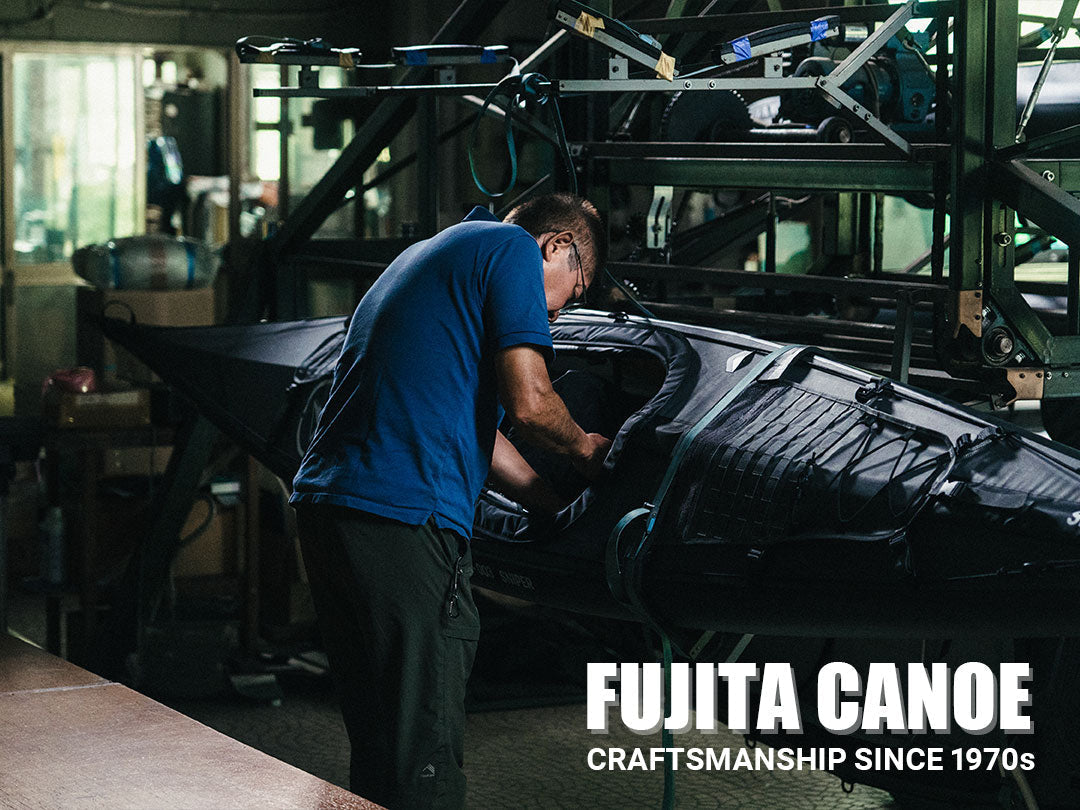

Fujita Canoe, located in Kasagi Town, Kyoto Prefecture.
This is where all FOLBOT folding kayaks are born, a place where passion and technology come together.
This time, we'll give you a behind-the-scenes look at Fujita Canoe, a company with over 50 years of history, dedicated solely to folding kayaks.
The Founder of Fujita Canoe and the Evolution of its Technology

The founder, Kiyoshi Fujita (1930-2022), discovered his passion for canoes through a fateful encounter with his mentor, Professor Kosaburo Takagi of Kyoto University.
For 15 years before establishing his own company, Fujita worked at five leading companies, including Sumitomo Electric Industries, Yamaha Motor, and Victor Company of Japan, immersing himself in the research of rubber, plywood, marine theory, and mass production technology.
This invaluable experience, which could be described as a "domestic canoe study abroad," laid the foundation for Fujita Canoe's advanced technological capabilities today.
Today, the second generation has inherited Fujita Canoe's technological prowess and passionate commitment to manufacturing.

The Encounter Between "Fujita Canoe" and FOLBOT

The encounter between "Fujita Canoe" and "FOLBOT" dates back to 2020.
When we decided to launch "FOLBOT" and were looking for a kayak production factory, the kayak that the "FOLBOT" designer was using at the time was from "Fujita Canoe."
The designer had used Fujita Canoe's kayaks extensively and was captivated by their appeal.
We believed that this was the only production factory that combined the "folding" aspect, a key brand keyword for "FOLBOT," with "meticulous craftsmanship," so we made a sudden phone appointment and visited Kyoto.
Initially, the staff at "Fujita Canoe" were suspicious, wondering, "Who are these people making a sudden production request?" but after our second visit, they agreed to undertake the production of "FOLBOT" kayaks.

Five years have passed since then. FOLBOT's kayaks would not be possible without the cooperation of Fujita Canoe.
To commemorate the launch of two new kayak models, "SNIPER" and "WATER ARMOR", we will take a look behind the scenes at the manufacturing process at Fujita Canoe.
Uncompromising craftsmanship – good things, forever.
The frame production site where craftsmanship shines
On the first floor, immediately inside the factory entrance, the frames that form the skeleton of the kayaks are processed.

Aluminum pipes are mainly used.
Even though it's all aluminum, there are actually various types.
The aluminum is processed differently depending on the part of the frame.

Incidentally, in addition to conventional aluminum materials, the new "SNIPER" model also partially incorporates lightweight, break-resistant, and highly elastic fiberglass.

Processing begins with cutting the pipes, followed by careful deburring and delicate bending.

Craftsmen adjust for subtle differences in each lot, using years of experience and skill to shape the pieces.


The bent parts are then rigorously checked against dedicated wooden jigs to ensure they meet the design specifications.

After inspection, the process moves to connecting the frames.
Even at this stage, skilled craftsmanship is evident.


In addition to aluminum frames, plastic parts used for seatbacks and coaming (cockpit edges) are also cut and manufactured.
This is how the kayak frames are created.


"Welding" technology to prevent water ingress shines through - even with meticulous logo printing -

On the first floor, in addition to frame processing, the "hull fabric" that covers the kayak frame is cut.
These cut pieces are joined together on the third floor.

Even after cutting, the fabric can be 3 to 5 meters long and heavy, making it strenuous to handle.
The floor is designed to make it as easy to handle as possible.

Brand logos and other prints on the hull fabric are carefully applied one by one using a silk screen technique within the factory.

Now, finally, the fabric pieces are joined together.

The bottom part that comes into contact with water is not sewn, but rather connected using a "welding" method, where the fabric is melted together using a high-frequency welder.
This prevents water from entering because there are no needle holes.


The completed kayak then moves to the final assembly inspection process.
Installed in the open atrium is a one-off kayak gondola designed by the previous generation when the factory was built.
After inspection, the kayaks are conditioned with their frames and hull fabric and quietly await shipment on this gondola.


For long-term use, intentional "stitching." Personalized maintenance and repair services

The philosophy of "wanting people to use good things for a long time" breathes through Fujita Canoe's products.
No matter how durable the materials used, the hull fabric can thin and tear when interacting with nature, requiring repairs.
For such cases, the deck (upper part) and bottom (lower part) of the kayak are intentionally joined with "stitching."
This is a consideration to allow only the damaged part to be removed and replaced.
If you purchase a FOLBOT kayak, a repair kit is also included, so you can fix small damages yourself. Even in the case of larger damages, repairs such as patching can be done at the factory.
Repair methods are also proposed and discussed with the customer before being decided.
In the factory, there was a kayak that President Fujita had cherished for many years, used extensively with repeated repairs and reinforcements, which spoke volumes about its durability and ease of repair.

Over 50 years of history dedicated to kayaks - precious materials and passionate dedication -

On the second floor, valuable documents such as the wooden-framed kayaks created by the previous generation are stored, allowing visitors to trace the footsteps and passionate dedication of over 50 years solely devoted to kayaks.


Contributing to the spread of recreational canoeing as the "birthplace of recreational canoeing"
Right next to the factory is the Kizu River, known as a sacred place for canoeing in Kansai, where a stone monument erected by the previous president marks it as "the birthplace of recreational canoeing."

New kayaks are often developed through repeated test rides on this river.

It was indeed an ideal location for a canoe and kayak production base.

Fujita Canoe also hosts schools on the Kizu River, actively contributing to the promotion of water activities.

What did you think?
Fujita Canoe meticulously produces each kayak, dedicating heart to every step, so that users can enjoy them for a long time.
It felt like more than just a production facility; it was a place where deep love for kayaks and consideration for the people who receive them take shape.
Fujita Canoe and FOLBOT will continue to create kayaks that everyone loves, now and in the future.