

This is the second installment of our series introducing great spots for kayaking and SUP.
This time, we're introducing a spot right in Tokyo's 23 wards! The route starts from the riverbank next to Oshima Komatsugawa Park, which spans Koto and Edogawa wards, and takes you through the Tokyo canals.
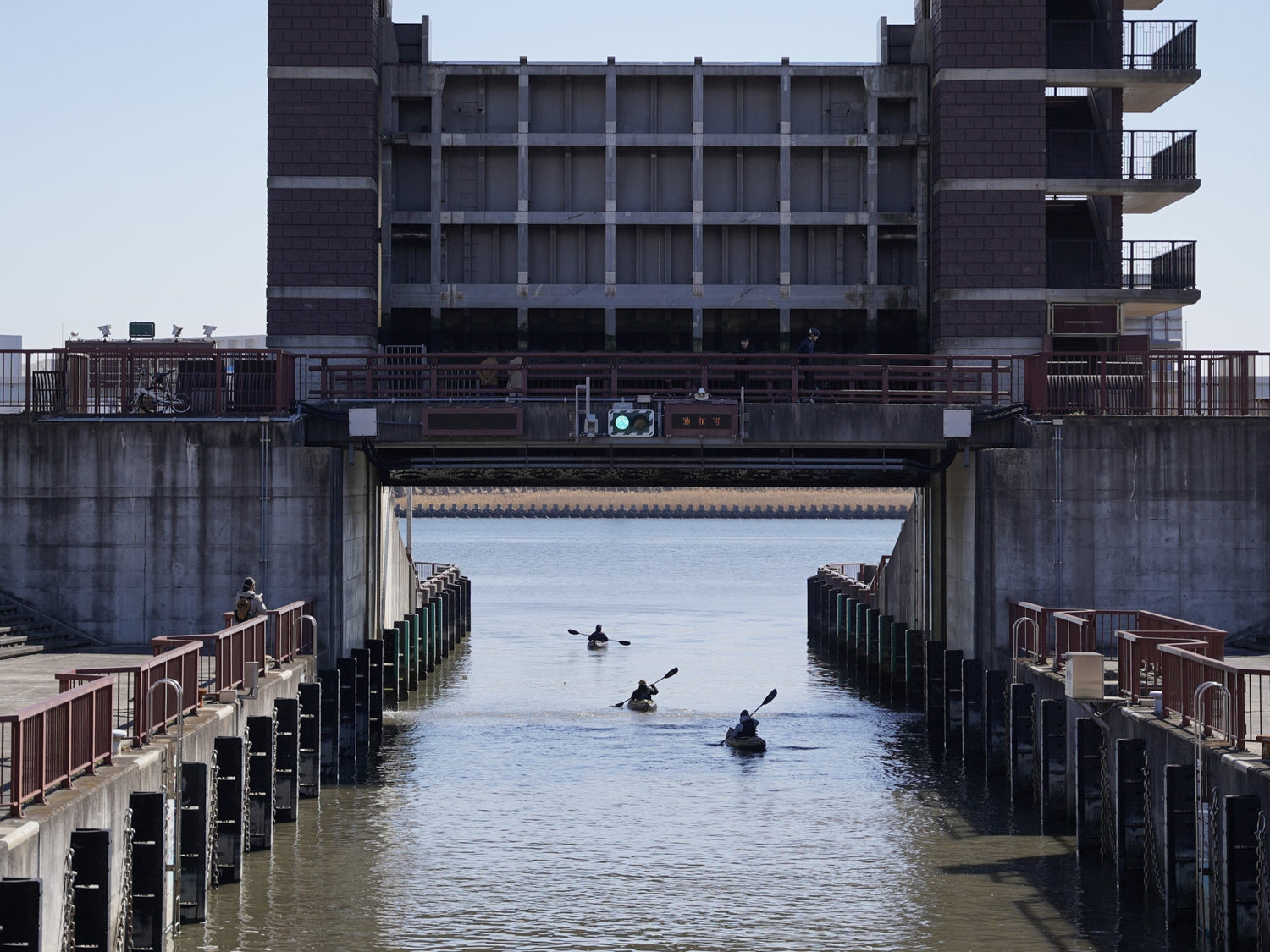
Highlights include the Tokyo Skytree and the Arakawa Lock Gate.
This tour allows you to experience massive structures from a zero-meter perspective.

The starting point, as mentioned at the beginning, is the former Nakagawa riverbank next to Oshima Komatsugawa Park.
Oshima Komatsugawa Park has a parking lot, making it accessible by car.
The parking lot is very convenient, just 2-3 minutes across the road from the riverbank, but
be aware that it can get full on weekends, especially during cherry blossom season.

This time, to take advantage of the convenient city center location, we will be using public transportation.
All FOLBOT kayaks and SUPs can be folded for transport, so they can be brought on public transportation such as buses, trains, and airplanes.
Utilizing this feature, we chose a route this time that involves walking from Higashi-Ojima Station on the Toei Shinjuku Line.
Since no driving is required, you can even enjoy a drink at an izakaya on the way back!

It's about a 10-minute walk from the station to the launch point on the former Nakagawa riverbank.

Once you arrive at the riverbank, the first step is to assemble the kayak.
We're used to it, so we can assemble it in about 15 minutes.

There's a convenient ramp at the starting point for launching. Local canoe clubs and school sports teams also use it, so let's share the space during busy times.
From the ramp towards the river,
going left (downstream) leads to the Arakawa Lock Gate
going right (upstream) leads to the Skytree route.
First, let's head towards the Arakawa Lock Gate.

It's a universal rule for boats (including kayaks and SUPs) to keep to the right.
If you encounter oncoming boats or kayaks, both parties should move to the right to avoid each other.

After paddling a bit, we pass the Oshima Station where we disembarked earlier.
It's rare to see a station built over a river, isn't it?
Usually, I paddle in nature, but today's scenery is right in the middle of a city.
The intense sense of the extraordinary fills me with excitement, and my paddling becomes lighter.

Further on, the Arakawa Lock Gate comes into view.

What exactly is the Arakawa Lock Gate, you ask?
Simply put, it's a sluice gate that adjusts the water level to allow boats to travel between the former Nakagawa River and the Arakawa River, which have different water levels.For more details, please refer here.
By the way, the method of passing through the Panama Canal, a key hub for global logistics, is also the same lock gate system.You can experience this with your own kayak, and for free, no less!

Signs indicating traffic restrictions are posted before the Arakawa Lock Gate.
Although not visible in the photo, there is a traffic light and an electronic signboard nearby, so proceed according to the instructions displayed there.
As you get closer to the gate, the facility staff will guide you via loudspeaker.
If there's a boat coming from the other side, the signal will turn red, so you'll need to wait for a while. For detailed instructions on how to pass through, please check here.

Water droplets fall like rain from the sluice gate that has just been raised from the water. You will definitely get wet when passing through, so it's recommended to wear clothes that can get wet or dirty.

Once inside the gate, first grab onto the chain on the side wall to secure your boat so it doesn't move.
Since the former Nakagawa River has a lower water level than the Arakawa River, on this day, the water level inside the gate is raised by about 1.9m before the Arakawa side sluice gate is opened.
The process of closing the entry gate, adjusting the water level, and then opening the opposite gate takes about 15-20 minutes to pass through, but for an unknown experience, it felt like it flew by.

Once the opposite gate opens and the signal turns green, we set off into the Arakawa River.

The scenery changed completely from before, and the vast Arakawa River stretched out before us.
I never imagined the day would come when I'd see the elevated Metropolitan Expressway, which I usually drive on, from the surface of the river.

A view of the gate from the Arakawa side.
If you're coming right back, they'll keep the sluice gate open for you.
They asked over the loudspeaker if I was coming back immediately, and I replied with a circle hand signal.

After paddling around the gate for about 10 minutes and taking photos, we returned inside the gate.
As before, the water level was adjusted inside the gate, and we re-entered the former Nakagawa River.

Following the same route as we came, we returned to our starting point.
After lunch and a restroom break at the park, we finally headed for the Tokyo Skytree.
We will introduce the route to Skytree in detail in the next article.
≪Launch Point≫
Former Nakagawa Riverbank
There is a parking lot at Oshima Komatsugawa Park on the opposite side of the road.
Be aware that the parking lot can get full during cherry blossom season.
It is also accessible on foot from Higashi-Ojima Station on the Toei Shinjuku Line.
≪Highlights≫
The impressive Arakawa Lock Gate
The extraordinary experience of paddling through the city center
Excellent access by both car and train
≪Points to Note≫
Be careful of collisions with kayaks and SUPs
Follow the traffic rules for the Arakawa Lock Gate
≪Recommended Nearby Spots≫
Oshima Komatsugawa Park
Koto City Nakagawa Funabansho Museum
*Information is current at the time of writing.
Please always check the latest information yourself and enjoy responsibly by following the rules!